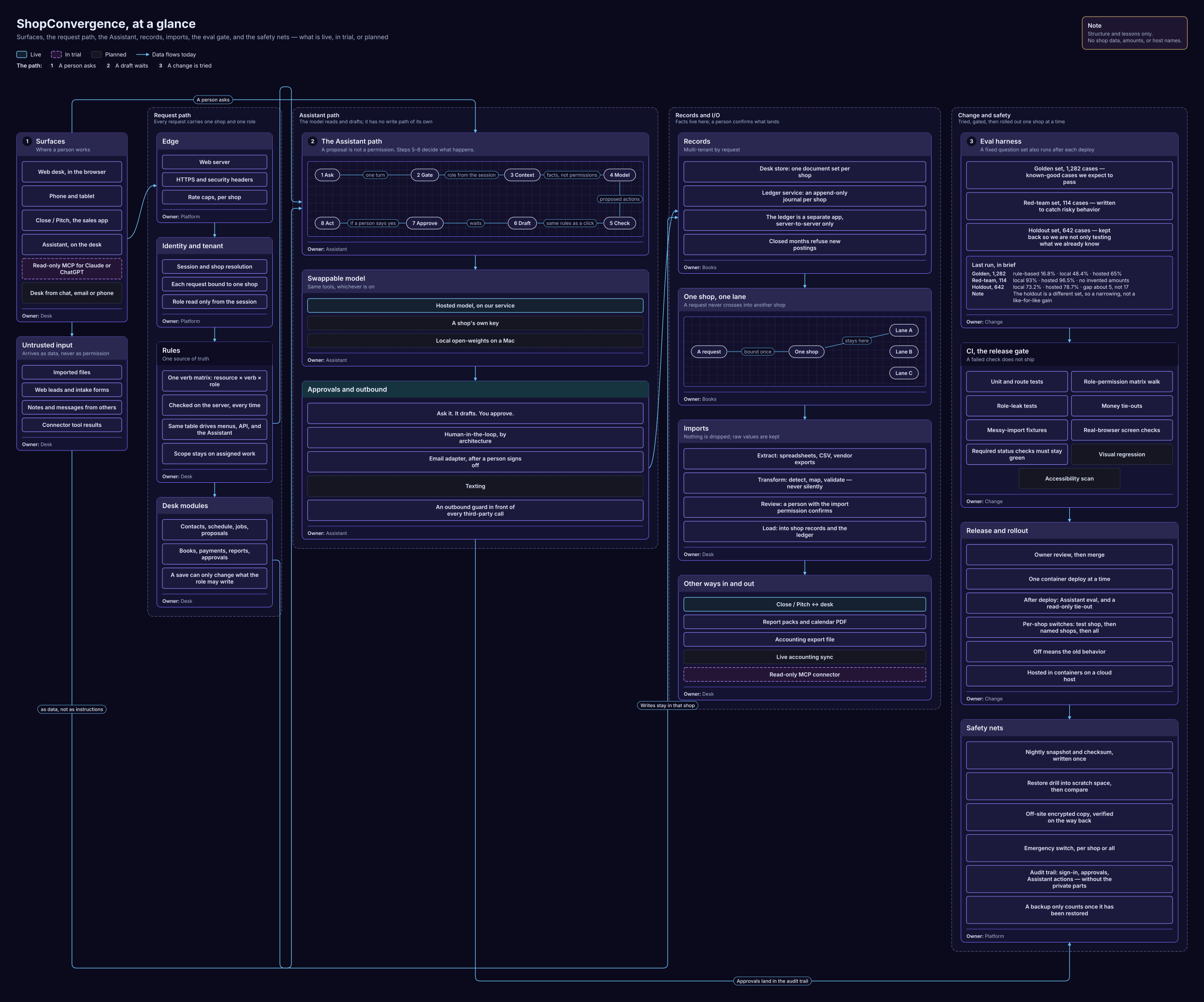
At a glance
A person works in the web desk, on a phone or tablet, or in Close / Pitch. They can ask an Assistant in ordinary language. A request is bound to one shop and one role at the edge, then checked against a single rules table on the server — the same table that drives the menus, the API, and the Assistant's capability list.
The model can be swapped: a hosted model is live; a shop's own key, and a local open-weights model on a Mac, are planned. Native tool calling, including MCP (Model Context Protocol, a standard way for a model to use tools), goes through the server. Untrusted input — imports, web leads, other people's notes, connector results — arrives as data, never as permission. A proposal is not a permission. Ask it. It drafts. You approve. That is human-in-the-loop, or HITL, by architecture.
Records are multi-tenant: one shop per tenant, with a separate ledger journal per shop. Imports are extracted, mapped, and confirmed by a person before they load. A change is scored in an eval harness (golden, red-team, and holdout sets), then held by required status checks in CI. Features roll out behind per-shop switches. Nightly snapshots are restored and compared before they count. The desk runs in containers on a cloud host.
Four layers
Top is where you ask. Bottom is where the facts live. Crew is the desk, the Assistant, and Close / Pitch. Rules holds roles, permissions, and approvals. Ledger holds the books, with one shop per tenant, and imports that a person confirms. Anywhere — the desk from chat, email, or phone — is still to come, except for a read-only MCP connector that a shop can allow for Claude or ChatGPT.
The runtime
A person works in the browser, or in Close / Pitch on a tablet, and may ask the Assistant. The request hits the edge, is bound to one shop, and is checked against the rules table. The model behind the Assistant can be swapped without rebuilding the rest of the desk. Tool calls are not a private door: they use the same server-side checks as a click. Then a person decides. Ledger and books are a separate path, and writes wait on approval.
The Assistant
You ask in ordinary language, on the desk you already use, one action per turn. A gate takes the role from the session, never from the chat text, and can pause the Assistant. Facts are pulled server-side and filtered by role. The model can be a hosted model, or later a shop's own key or a local open-weights model on a Mac. When it needs to look something up or prepare an action, it uses native tool calling. MCP is simply the name of that interface.
Every proposed action is re-checked against the same rules as a click. A shop can also allow a read-only MCP connector so Claude or ChatGPT can use the same desk. Drafts from those apps, still stopping in Approvals, are planned. In every case the model has no write path of its own.
How a change is tried
A golden set is a known-good collection we expect to pass — here, 1,282 cases. A red-team set is written to catch risky or off-limits behavior — here, 114 cases; on the last run neither model invented an amount, and the permission checks held. A holdout set is kept back so we are not only testing what we already know — here, 642 cases. After rewording the tool definitions, the local model reached 73.2% and the hosted model 78.7% on that holdout, a gap of about 5 points, down from 17 on the golden set. The holdout is a different case set, so that is a narrowing, not a like-for-like gain.
CI is the release gate: unit and route tests, a role-permission matrix walk, role-leak tests, money tie-outs, messy-import fixtures, and real-browser screen checks. Required status checks are the tests that must stay green before a change can merge or release. Visual regression and an accessibility scan are planned. After deploy, the Assistant eval and a read-only tie-out run again. New behavior sits behind a per-shop switch, so “deployed” and “turned on for a shop” are separate decisions. A backup only counts once it has been restored.